
Loss and Grief Bible Verses That Actually Help a Grieving Child
Curated insights from Sissy Goff, LPC-MHSP | Published October 28, 2026
The loss and grief Bible verses that help a grieving child are the ones that name the sorrow before they promise the hope: 1 Thessalonians 4:13–14, Psalm 30:5, Hebrews 12:1–2, John 16:22, and Romans 5:3–4. Each holds grief and hope together rather than trading one for the other.
Takeaways:
The Bible does not ask a grieving child to skip the sorrow
Christian grief is different because it is framed with hope
Counselor Sissy Goff's three truths—you are not alone, you will be okay, this is not the end—sort verses by the question a child is actually asking
Nine Bible quotes about loss and grief, each matched to the specific reassurance it delivers
What the Bible Says About Loss and Grief
Scripture validates grief. The Psalms are full of people telling God exactly how angry they are with him and why. Ephesians 4:26 instructs readers not to sin in their anger, a command that knows the anger will come. In John 11, Jesus weeps at the tomb of Lazarus even though he knows he is moments from raising him. From the cross he cries out, “My God, my God, why have you forsaken me?”
Sissy Goff, LPC-MHSP, executive director of Daystar Counseling Ministries in Nashville and a therapist who has spent more than three decades with kids and parents, reads those tears as evidence of a God who knows our pain. In her book, Helping Kids Through Grief: A Parent’s Guide for Making Sense of Death, Processing Loss, and Finding Hope, she writes that God “knows the silence. The anguish. The emptiness we feel in all of the ways” (p. 24).
One important key is that our grief, as Christians, is framed in hope. In 1 Thessalonians, Paul does not tell the church to stop grieving. He tells them not to grieve “like those who have no hope,” then anchors that hope not in a feeling, but in the death and resurrection of Jesus Christ. God will bring with him those who have fallen asleep in him (NIV).
“Our sorrow—our heartache—our grief is not the end. . . . As much as this book can, I want it to be my way of saying . . . I’m in it with you. And so is the God who went to death on a cross on our behalf. You are not alone. This is not the end of the story. For you or for your child. You’re going to get through this. And so is your child. Easter is coming. Always.”

The Three Truths Framework: Which Verse for Which Moment
Goff organizes the hope she wants grieving children to hear into three truths, and each one has a scriptural anchor. The framework closes her book and works well as a filter for choosing Bible quotes about loss and grief, because it sorts verses by the question a child is actually asking rather than by theme.
| Truth | The question underneath | Anchors |
|---|---|---|
| You are not alone | Does anyone know how this feels? | Matthew 27:46 |
| You will be okay | Will I always feel like this? | Psalm 30:5, Romans 5:3–4, 1 Corinthians 13:11–12 |
| This is not the end | Where did they go? | 1 Thessalonians 4:13, John 16:22, Hebrews 12:1–2 |
Truth 1: You Are Not Alone
The verses that serve this truth are the ones where God grieves. Matthew 27:46 establish that sorrow is not a place God avoids. Goff traces an important phrase we see throughout her book to a college student comforting her middle school brother during a group session on the crucifixion. He said he felt stuck in the blankness between the cross and Easter. She knelt in front of him and told him her three days were his three days. Holy Saturday is the location most grieving families occupy. Naming it gives a child a place to stand that is neither denial nor despair.
Truth 2: You Will Be Okay
Psalm 30:5 is the verse most often reached for here, and it works when the emphasis falls on the night rather than the morning. Goff keeps a paraphrase of it on the wall of her counseling office, one that ends with a single word: wait. Romans 5:3–4 makes the same move at a slower pace, tracing suffering through perseverance and character to hope.
“Outside of the person and resurrection of Jesus, suffering is the only pathway to hope laid out directly in Scripture.”
For older children who want to know why they cannot make sense of any of it, 1 Corinthians 13:11–12 (ESV) is helpful. Paul describes seeing in a mirror dimly and knowing only in part. Goff notes the strangeness of the most famous chapter on love pivoting to obscured sight and treats it as permission for a child not to understand yet.
Truth 3: This Is Not the End
1 Thessalonians 4:13–14 and John 16:22 (ESV) carry this truth, and Hebrews 12:1–2 makes it usable with younger children. Goff describes a pastor at the funeral of an eight-year-old girl who compared Christian grief to a piece of art and said it is always framed by hope. Her church lights candles on All Saints’ Day and returns to the cloud of witnesses in Hebrews. In counseling, she asks children who is in their cloud, and what they are saying to cheer them on. The verse becomes a therapeutic exercise.
9 Bible Verses About Loss and Grief, Matched to What a Child Needs
The table below pairs Bible passages from the book with the specific reassurance they deliver.
| Scripture Reference | Passage | Version | What it tells a grieving child |
|---|---|---|---|
| 1 Thessalonians 4:13–14 | Brothers and sisters, we do not want you to be uninformed about those who sleep in death, so that you do not grieve like the rest of mankind, who have no hope. For we believe that Jesus died and rose again, and so we believe that God will bring with Jesus those who have fallen asleep in him. | NIV | Grief is expected of believers. It is framed by hope. |
| Psalm 30:5 | Weeping may stay for the night, but rejoicing comes in the morning. | NIV | The night of weeping has a morning. Waiting is part of the promise. |
| Hebrews 12:1–2 | Therefore, since we are surrounded by such a great cloud of witnesses, let us throw off everything that hinders and the sin that so easily entangles. And let us run with perseverance the race marked out for us, fixing our eyes on Jesus, the pioneer and perfecter of faith. For the joy set before him he endured the cross, scorning its shame, and sat down at the right hand of the throne of God. | NIV | The person they lost belongs to a cloud of witnesses still cheering them on. |
| John 16:22 | So also you have sorrow now, but I will see you again, and your hearts will rejoice, and no one will take your joy from you. | ESV | There is sorrow now, but the Lord gives joy. |
| Romans 5:3–4 | Not only so, but we also glory in our sufferings, because we know that suffering produces perseverance; perseverance, character; and character, hope. | NIV | Suffering is a road to hope rather than a detour away from it. |
| 1 Corinthians 13:7–8, 11–12 | Love bears all things, believes all things, hopes all things, endures all things. Love never ends. As for prophecies, they will pass away; as for tongues, they will cease; as for knowledge, it will pass away. . . . When I was a child, I spoke like a child, I thought like a child, I reasoned like a child. When I became a man, I gave up childish ways. For now we see in a mirror dimly, but then face to face. Now I know in part; then I shall know fully, even as I have been fully known. | ESV | Not understanding is normal and it is not weak faith. |
| Ephesians 4:26 | “In your anger do not sin.” Do not let the sun go down while you are still angry. | NIV | Anger is assumed. What a child does with it is what matters. |
| Matthew 11:28–30 | Are you tired? Worn out? Burned out on religion? Come to me. Get away with me and you’ll recover your life. I’ll show you how to take a real rest. Walk with me and work with me—watch how I do it. Learn the unforced rhythms of grace. I won’t lay anything heavy or ill-fitting on you. Keep company with me and you’ll learn to live freely and lightly. | The Message | Rest is offered to the exhausted, including the exhausted parent doing the comforting. |
| 2 Peter 1:3 | His divine power has granted to us all things that pertain to life and godliness, through the knowledge of him who called us to his own glory and excellence. | ESV | All things that pertain to life. Which also means death, as an inevitable part of life. He has given and will give you and the grieving child everything you both need to know. |
How to Use These Verses Without Rushing a Child
Here are a few practices from the many found in the book to help you:
Say the concrete thing before the comforting thing. “Your grandmother died this morning” comes before any verse about resurrection.
Let the child’s questions set the pace. Read one passage, then ask what questions they have about it.
Revisit the same verse over months and years. Grief is not linear, and a child’s understanding of a passage grows as they do.
Make the verse an activity where you can. The cloud of witnesses in Hebrews 12 invites a child to describe who is in theirs.
Do your own grief work separately. Unprocessed adult grief spills sideways onto children, and no verse compensates for that.
Frequently Asked Questions
What Bible verses help a grieving child?
The most useful passages for a grieving child are 1 Thessalonians 4:13–14, Psalm 30:5, Hebrews 12:1–2, and John 16:22. Each acknowledges sorrow before offering hope. Verses that skip straight to comfort tend to teach a child that their sadness is unwelcome.
What does the Bible say about grief and loss?
The Bible treats grief as an expected human response rather than a spiritual failure. Paul instructs believers not to grieve as those without hope, which permits the grief and redirects its journey. Jesus weeps at the tomb of Lazarus, the Psalms record open anger toward God, and Romans 5:3–4 places suffering on the road to hope.
Is it okay to be angry at God after someone dies?
Yes, and Scripture models it. The Psalms are full of people telling God exactly how angry they are and why, and Ephesians 4:26 assumes anger will come while addressing what is done with it. Goff tells grieving parents plainly that God can handle their anger. For children, the practical work is helping the anger come out in healthy ways, because unexpressed anger tends to surface disproportionately and land on someone who did not earn it.
How are grief and loss in childhood different from adult grief?
Children re-grieve the same loss as they develop. A child who loses a parent at seven will grieve that loss again at twelve and again at seventeen, each time with more capacity to understand what happened. Grief in childhood also tends to surface indirectly, as regression, dropping grades, attention-seeking behavior, or headaches and stomachaches rather than as visible sadness. Younger children may believe their own behavior caused the death, a feature of magical thinking that requires direct correction.
Further Reading
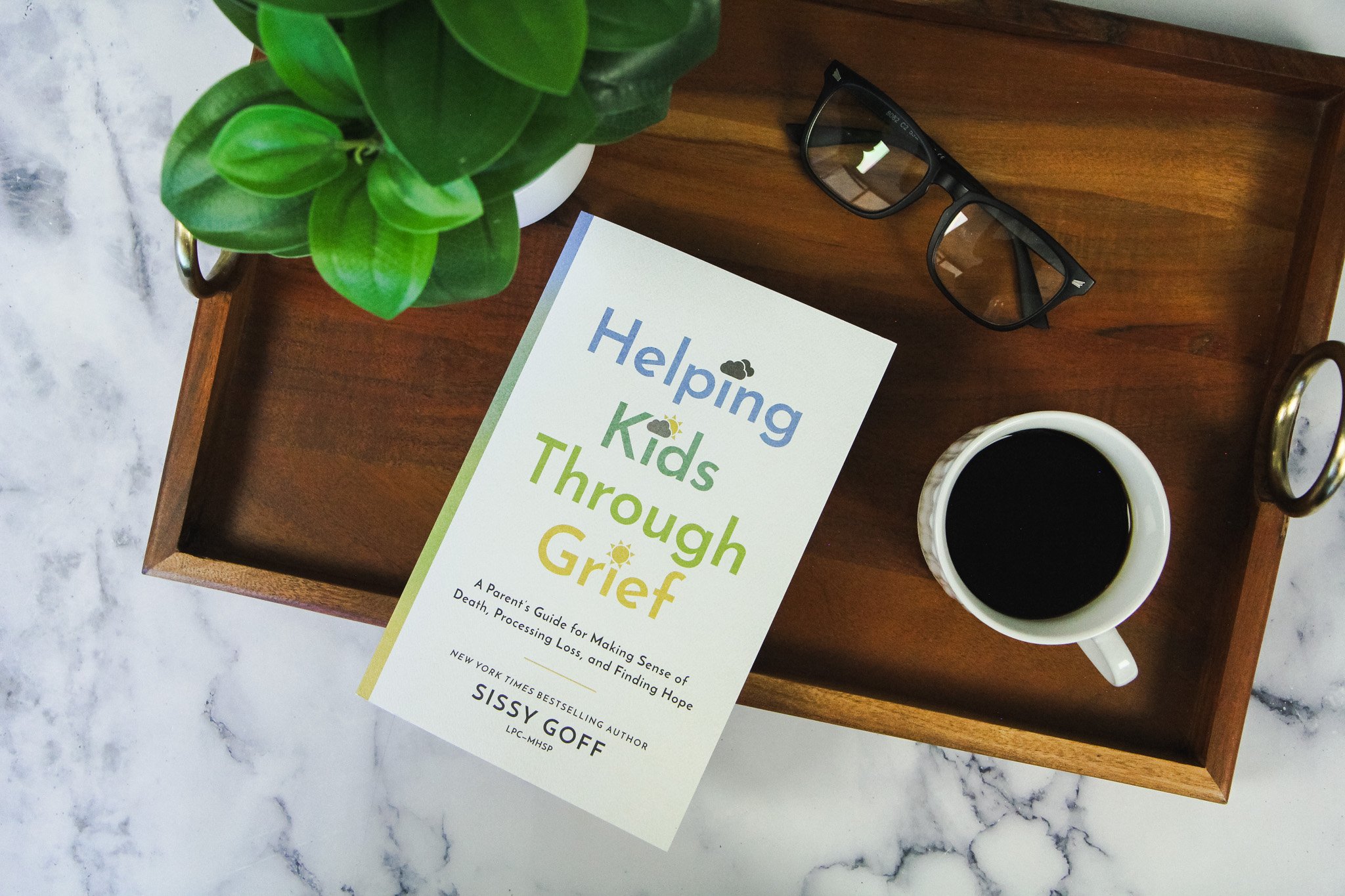
Sissy Goff, LPC-MHSP, is the executive director of Daystar Counseling Ministries in Nashville, where she has spent more than three decades with kids and parents, and she walked closely with the families of The Covenant School after the March 2023 shooting. Helping Kids Through Grief delivers what an article cannot: the age-by-age developmental map, the scripts for explaining suicide, homicide, miscarriage, and terminal illness to a child, and the taxonomy of grief types that tells a parent when to call a therapist. It is written for the parent who has to have the conversation this week.
This article was drafted with an AI research tool and reviewed and verified against the source manuscript by Stephanie Smith, Marketing Manager at Baker Publishing Group. Sources drawn from Helping Kids Through Grief: A Parent's Guide for Making Sense of Death, Processing Loss, and Finding Hope by Sissy Goff, Bethany House Publishers, 2026, pages 12–13, 18, 24–25, 63, 78, 79, 86, 92, 142, 150, 153, and 157–164.
Scripture credits
Scripture quotations marked NIV are taken from the Holy Bible, New International Version®, NIV®. Copyright © 1973, 1978, 1984, 2011 by Biblica, Inc.® Used by permission of Zondervan. All rights reserved worldwide. www.zondervan.com. The "NIV" and "New International Version" are trademarks registered in the United States Patent and Trademark Office by Biblica, Inc.®
Scripture quotations marked ESV are taken from the ESV® Bible (The Holy Bible, English Standard Version®), © 2001 by Crossway, a publishing ministry of Good News Publishers. ESV Text Edition: 2025. Used by permission. All rights reserved.
Scripture quotations marked The Message are taken from The Message, copyright © 1993, 2002, 2018 by Eugene H. Peterson. Used by permission of NavPress. All rights reserved. Represented by Tyndale House Publishers.